Editorial method
Who makes this, how, and why
YoriPrep Editorial focuses each guide on one operating decision a food-service team can use on its next shift.
- Reference material only
- This article is general operating reference material.
- Case scope
- This reference scope is limited to the operating question and illustrative case described in “From correction request to signatures and retention: the YoriPrep contract workflow”.
- Calculation limits
- The review formula is “Manage not just the wording but also the correction request, signer, finalization time, delivery, and retention.”; it does not determine a store-specific result without current inputs and context.
- Date markers from linked sources
- Years stated by the linked sources: 2016 · 2022 · 2025. Undated sources are not treated as current; check each link for its present status.
- Professional decisions
- Tax, employment, food-safety, accounting, and legal decisions need current official guidance or advice from an appropriate qualified professional. This article has not received that professional review.
- Publisher
- YoriPrep Editorial at Uberion selects the topic and is responsible for the scope of sources and examples in each article.
- Method
- Public sources are linked directly, and unsourced figures, percentages, and situations are labelled as illustrative. AI may assist drafting or translation, but advertising is limited to source-checked, curated articles.
- Purpose
- We publish to help readers solve one cost, stock, prep, or team-operations problem, not to mass-produce pages for search traffic.
The heart of an electronic contract is not the drawn signature. It is the ability to reconstruct who reviewed which version, when it became final, and how the final document was delivered and retained.
Fictional problem scenario · Two final files
The worker and the owner had different “final” contracts
The people, restaurant, filenames, and times below are fictional and used only to explain the workflow. This is not a real dispute or customer case.- Fictional restaurant
- Brunch café “Afternoon Table”
- Parties
- Owner Jiwoo · Worker Doyun
- Correction
- Workplace and break-time change
- Failure
- Email, messenger, and print versions did not match
“The worker messaged that the break should be one hour, not thirty minutes, and I changed the spreadsheet. But they signed the earlier PDF. I no longer know which file is final. Is an electronic signature alone enough?”
A signature image alone does not explain the revision, final content, or delivery. Link the correction request to a specific contract, let the manager create a revised draft, have the worker review that version in their own account, lock the document after both signatures, and make sure both parties retain the final copy.
Phase 1 · Attach the correction request to a contract version
Doyun’s message only said “please fix the break time” and did not identify a file or clause. Jiwoo overwrote the spreadsheet, so the old and revised documents could no longer be compared.
A correction should record the target contract name, requester, time, and concrete reason. “Doyun contract draft 1 · change break 19:00–19:30 to 19:00–20:00” gives the manager a precise scope to review.
The first failure was leaving the correction in a chat thread disconnected from the contract version.
Phase 2 · Edit before signing, lock after signing
The manager reviews the request, edits the relevant field, and previews the entire revised document. The worker opens the final draft under their own account and confirms that the correction appears before signing.
If a signed contract remains editable, it becomes unclear what the parties accepted. Korean Ministry guidance on electronic employment contracts recommends safeguards that prevent either party from changing the final document unilaterally after completion or signature.
Separating editable and finalized states preserves the content that existed at the signing time.
Phase 3 · Do not treat portal access and completed delivery as the same event
A worker’s ability to open a document in a portal does not automatically prove that the legal delivery duty is satisfied. A Korean Ministry response explains that server-only storage may not be enough and discusses sending the contract to an information system designated by the worker or providing it directly when electronic receipt is not accepted.
Let the worker download or print the final document, and separately confirm the agreed delivery method. Korean rules identify employment contracts as records to preserve for three years from the end of employment, so staff-level contract lists, finalization time, and correction history help reconstruct the context.
The portal is a useful access point; completing delivery and statutory retention remains an operator responsibility.
Version and status checklist
Keep five states distinct from draft to retention
Manage not just the wording but also the correction request, signer, finalization time, delivery, and retention.Prepare the working conditions and employer signature while the document is still open for review.
Record the incorrect term clearly so the manager can verify whether it was addressed.
Read the whole contract again, not only the changed field, including pay, hours, and term.
The worker signs the final version in their console, and both sides lose editing access after finalization.
Deliver the final copy by download, print, or agreed transmission and manage the statutory retention period.
Reconstructing one fictional contract timeline
- 09:10
- Draft saved
- Manager · 30-minute break
- 11:42
- Correction requested
- Worker · asks for one-hour break
- 14:05
- Revision saved
- Manager · request reflected and employer signed
- 18:20
- Worker signed
- Worker console · finalized and locked
Request history + final content + both signatures + final time + delivery recordA reconstructable contract trailYoriPrep status records help explain the workflow. They do not replace an external certified e-signature service or legal audit, and the operator still needs a delivery record and retention policy.
This article explains general Korean electronic-employment-contract management and is not legal advice. YoriPrep’s staff-console signature is not an external certified e-signature service and does not guarantee the validity, delivery, evidentiary weight, or privacy compliance of an individual contract.
Evidence most easily lost in a fictional contract flow
Illustrative values show what becomes hard to reconstruct when content and status history are not kept together.
Overwriting files makes it difficult to prove what content was signed.
A messenger-only request becomes separated from the target contract and its resolution.
Record who finalized the contract and when it became locked.
Separate portal visibility from actual delivery and manage the retention start date.
These values are fictional. They are not measures of legal evidentiary weight or YoriPrep performance.
Official and product basis
Sources used for electronic records, delivery, and retention
The sources cover electronic-document requirements, Ministry interpretation of delivery, tamper prevention, and the retention start date for employment contracts.Ministry Response on Electronic Employment Contracts
Korea Ministry of Employment and Labor
It explains that electronic contracting is possible but server-only storage may not satisfy delivery, and discusses sending to a worker-designated system or direct delivery. The answer depends on specific facts and should be read with current law.
View sourceGuideline for Activating Electronic Employment Contracts
Korea Ministry of Employment and Labor
It addresses drafting, delivery, retention, and protection against unilateral modification after final signature. Review later statutory changes and workplace-specific requirements as well.
View sourceFramework Act on Electronic Documents and Transactions, Articles 4, 4-2, and 5
Korea Law Information Center
It states that electronic form alone does not deny legal effect and sets accessibility, reproducibility, and preservation conditions for electronic documents. Special rules in other statutes and the actual creation and storage method still matter.
View sourceEnforcement Decree of the Labor Standards Act, Article 22
Korea Law Information Center
It lists employment contracts among preserved records and starts the contract retention period when the employment relationship ends. Different documents have different starting dates, so review the complete provision.
View source
Let the manager and worker review the same contract
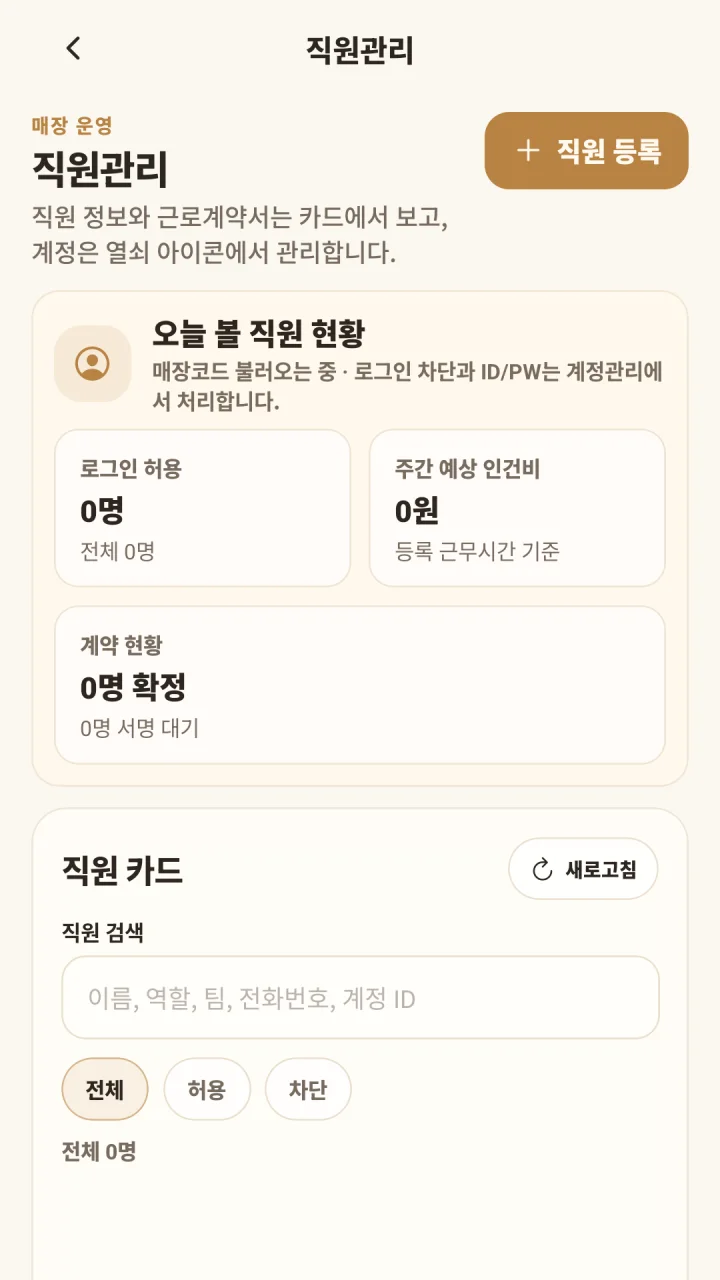
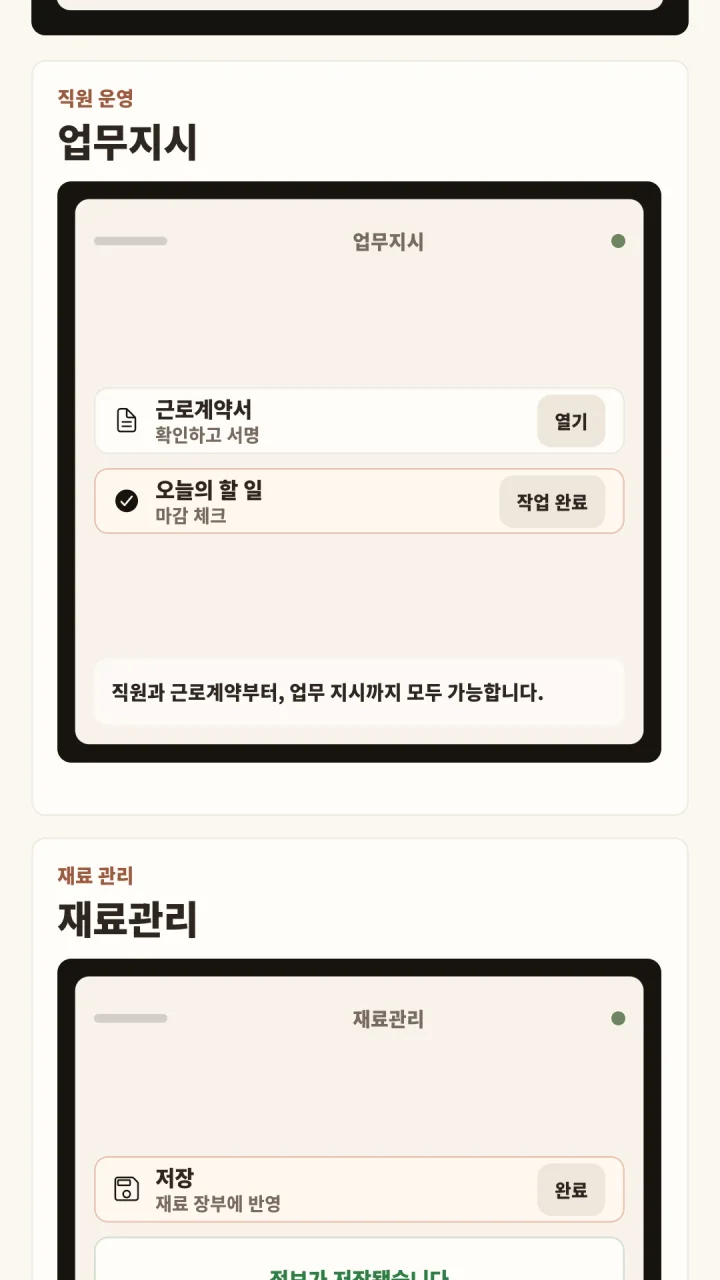
The manager creates and edits staff-level drafts and reviews correction requests. The worker can zoom, read, download, and print the contract in their own console, request a correction when content is wrong, and sign directly when it is correct. The signed contract is finalized and editing is blocked on both sides.
- The worker reviews the content first
They can zoom, read, download, or print the contract. If a term is wrong, they leave a correction request instead of signing.
- The manager revises and saves a new draft
They review the request and time, edit the relevant field, recheck the full document, and confirm the employer signature.
- The worker signs directly and the contract locks
The worker confirms the finalization notice before signing. Both parties lose editing access, while the operator separately completes delivery and statutory retention.