Editorial method
Who makes this, how, and why
YoriPrep Editorial focuses each guide on one operating decision a food-service team can use on its next shift.
- Reference material only
- This article is general operating reference material.
- Case scope
- This reference scope is limited to the operating question and illustrative case described in “What a Korean employment contract must include: a restaurant operator’s checklist”.
- Calculation limits
- The review formula is “The required terms can differ for general, fixed-term, and part-time workers. This sequence assumes a Korean workplace and provides general information, not case-specific legal advice.”; it does not determine a store-specific result without current inputs and context.
- Date markers from linked sources
- Years stated by the linked sources: 2025 · 2021 · 2016. 1 linked sources state no date. Undated sources are not treated as current; check each link for its present status.
- Professional decisions
- Tax, employment, food-safety, accounting, and legal decisions need current official guidance or advice from an appropriate qualified professional. This article has not received that professional review.
- Publisher
- YoriPrep Editorial at Uberion selects the topic and is responsible for the scope of sources and examples in each article.
- Method
- Public sources are linked directly, and unsourced figures, percentages, and situations are labelled as illustrative. AI may assist drafting or translation, but advertising is limited to source-checked, curated articles.
- Purpose
- We publish to help readers solve one cost, stock, prep, or team-operations problem, not to mass-produce pages for search traffic.
An employment contract is not mainly a signature page. It records the actual working conditions in one consistent document and gives the worker a copy they can retain.
Fictional problem scenario · A busy snack restaurant
“I was told five weekdays. Why am I scheduled on Saturday?”
The people, restaurant, amounts, and events below are fictional and used only to explain the method. This is not a YoriPrep customer story.- Fictional restaurant
- 12-seat snack shop “One Meal Station”
- Parties
- Owner Seojun · Worker Mina
- Dispute
- Workdays, breaks, hourly pay, and duties
- Document state
- One messenger photo and two conflicting spreadsheets
“I think I said Monday through Friday during the interview, but the contract only says ‘five days a week.’ We now remember Saturday cover, break time, and whether meal pay is included differently. What should I check first?”
Before deciding whose memory is better, rebuild the agreement one condition at a time. Replace phrases such as “five days a week” with actual workdays, hours, breaks, pay components, payday, location, and duties. If a condition changed, create a new version that both parties review instead of silently editing the old file.
Phase 1 · Find the gaps between the conversation and the document
Mina’s photo showed only the hourly rate and start time. Seojun’s spreadsheet treated a meal allowance as included in the rate. Neither file stated Saturday cover, exact break times, or payday.
In that condition, “we originally agreed” becomes an endless argument. Gather interview notes, schedules, and payroll assumptions in one place, then compare each item against the contract to separate omissions from genuine disagreements.
The dispute began because the same working condition was recorded differently across files, not because one side necessarily acted in bad faith.
Phase 2 · Separate statutory terms from restaurant operating rules
Article 17 of Korea’s Labor Standards Act requires the employer to specify wages, contractual working hours, holidays, annual paid leave, and other conditions set by presidential decree. A written document, including an electronic document, must be given to the worker for core items including wage components, calculation and payment method, hours, holidays, and annual paid leave.
For fixed-term or part-time workers, Korean law also requires written terms covering the contract period, hours and breaks, wages, holidays and leave, workplace and duties, plus working hours for each workday for part-time staff. Uniforms, meals, and lateness notifications are restaurant rules that should be written separately from the statutory minimum.
Statutory terms are the floor. Concrete restaurant conditions are still needed to prevent day-to-day misunderstandings.
Phase 3 · Replace vague phrases with values people can verify
Phrases such as “five days a week,” “overtime when needed,” or “allowances included” leave the scope open. Replace them with values such as Monday to Friday, 17:00–22:00, break 19:30–20:00, each wage component, the monthly payday, payment method, workplace, and duty range.
When working conditions change, preserve the earlier document and create a clearly identified new draft. Record that both parties reviewed the revised section, signed the final version, and completed delivery so the applicable terms can be reconstructed later.
A useful contract is not the longest document. It is one that produces the same schedule and payroll calculation next month.
Pre-signing checklist
Review at least these five groups before signing
The required terms can differ for general, fixed-term, and part-time workers. This sequence assumes a Korean workplace and provides general information, not case-specific legal advice.State whether the term is fixed and include the written contract period for a fixed-term worker.
If the worker may support another branch or cover both floor and kitchen duties, describe the conditions and limits.
For part-time staff, review hours for each workday and keep the schedule consistent with the contract.
Separate base pay, hourly pay, bonuses, and agreed allowances; avoid unclear “included” wording.
Writing the terms and actually giving the worker the final document are separate checks.
A final review of one fictional contract
- Schedule
- Mon–Fri 17:00–22:00
- Break 19:30–20:00 stated separately
- Pay
- KRW 12,000 per hour
- Bonus and agreed allowance stated separately, including zero
- Payment
- Bank transfer on the 10th
- Pay period and payment method confirmed
- Duties
- Guest service and closing
- Other-branch support addressed separately
Required terms + party review + both signatures + delivery to workerA final version that can be checkedResolve blanks as a value or “not applicable,” and give the worker time to request corrections before signing. Do not overwrite a signed final version.
This article is general information based on Korean law and is not legal advice. Required clauses can vary with business size, worker type, collective agreements, and the actual work arrangement. Confirm current requirements with Korea’s Ministry of Employment and Labor or a qualified labor or legal professional.
Illustrative risk inside an unclear contract
The example prioritizes terms that two parties are likely to interpret differently in a fictional contract review.
Unclear base pay, allowances, or inclusion rules produce different payroll results.
A schedule that conflicts with the contract creates repeated disputes about actual hours.
Clarify fixed-term status and the boundary of support at another location.
Review both the written terms and whether the final copy reached the worker.
These values explain review order. They are not legal weights or YoriPrep customer statistics.
Official basis
Sources used for the drafting standard
The statute and Ministry guidance were used to verify required terms, written delivery, and differences by worker type.Labor Standards Act, Article 17: Statement of Working Conditions
Korea Law Information Center
It requires wages, contractual working hours, holidays, annual paid leave, and other conditions to be specified, with core written terms delivered to the worker. Recheck the effective law and the applicability to the workplace at the time of contracting.
View sourceAct on the Protection of Fixed-Term and Part-Time Employees, Article 17
Korea Law Information Center
It lists written terms for fixed-term and part-time workers, including period, hours and breaks, wages, leave, workplace and duties, and per-day hours for part-time staff. Additional requirements depend on the legal classification of the worker.
View sourceStandard Employment Contract Forms
Korea Ministry of Employment and Labor
It provides reference forms for open-ended, fixed-term, part-time, and other work arrangements. Except for the foreign-worker form, the attachments are references and need workplace-specific review.
View sourceHow to Write an Employment Contract
Korea Ministry of Employment and Labor
It highlights clear documentation of wages, hours, holidays, and paid leave. Use the summary together with the current statute and applicable forms.
View source
Move from staff information to a standard contract draft in one flow
From a staff card, a manager can create a contract and edit term, workplace, duties, hours, breaks, wages, holidays, and additional terms before saving the employer signature. Korean standard, English, and Japanese document templates are available, but they do not automatically guarantee local legal compliance.
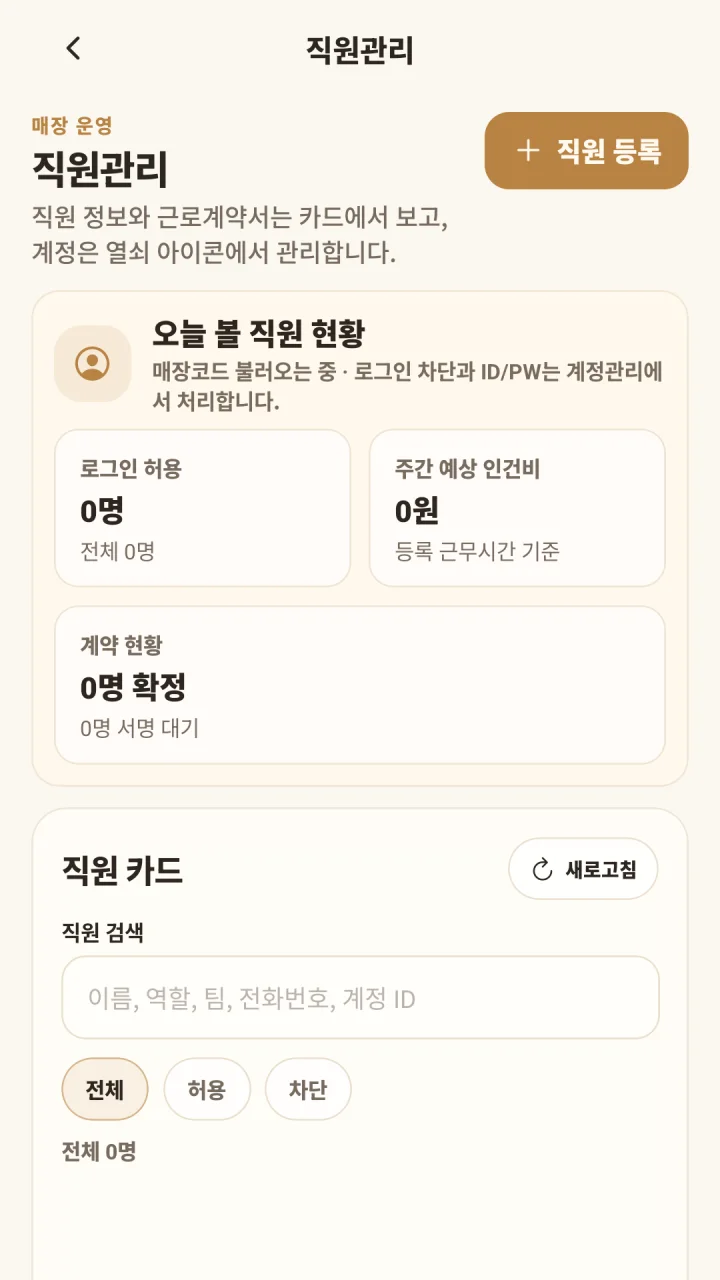
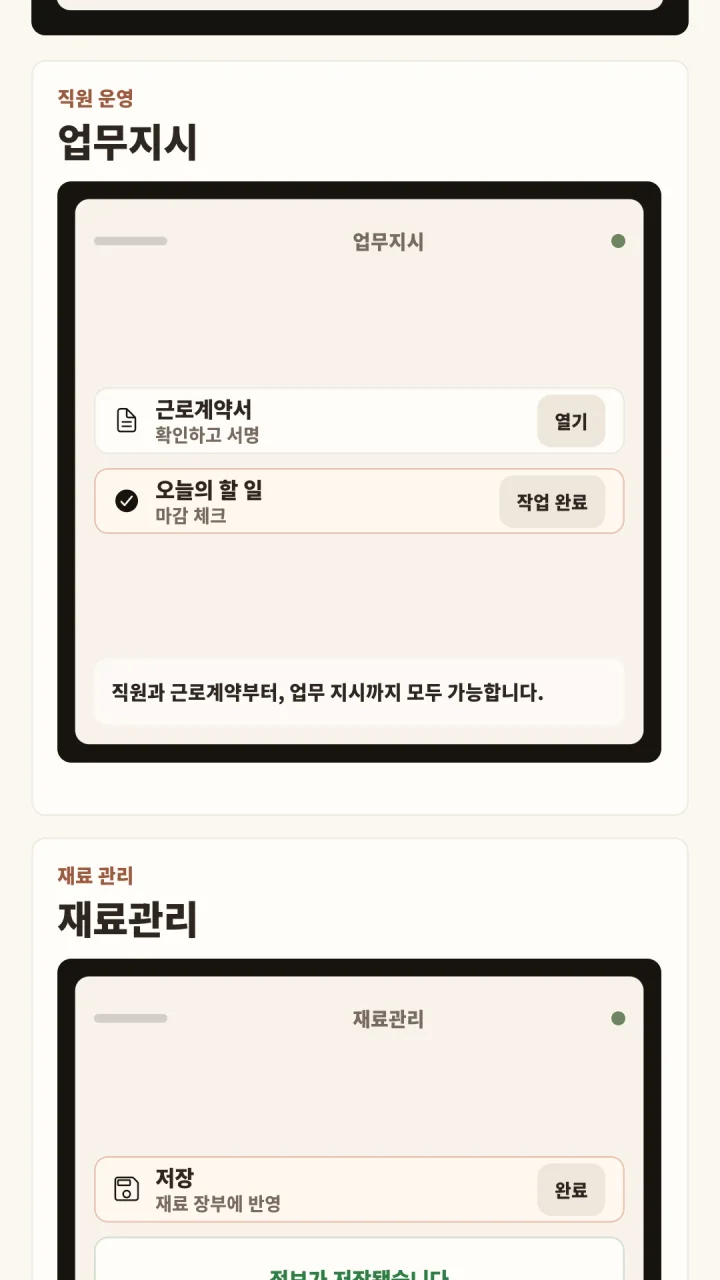
- Load staff and restaurant information
Confirm the worker, business, representative, work arrangement, fixed-term status, and document language.
- Complete each working-condition field
Match workplace, duties, workdays, hours, breaks, wages, payday, and holidays to the real schedule and payroll policy.
- Preview and add the employer signature
Review gaps and ambiguous language before the worker sees it, then save it as a draft rather than treating it as final.