Editorial method
Who makes this, how, and why
YoriPrep Editorial focuses each guide on one operating decision a food-service team can use on its next shift.
- Reference material only
- This article is general operating reference material.
- Case scope
- This reference scope is limited to the operating question and illustrative case described in “Why every restaurant needs a website and a QR menu”.
- Calculation limits
- The review formula is “This scoring model does not measure customer demand. It helps a reviewer prioritize fields that must be reconciled before the menu becomes operational data.”; it does not determine a store-specific result without current inputs and context.
- Date markers from linked sources
- Years stated by the linked sources: 2024 · 2018 · 2025. 1 linked sources state no date. Undated sources are not treated as current; check each link for its present status.
- Professional decisions
- Tax, employment, food-safety, accounting, and legal decisions need current official guidance or advice from an appropriate qualified professional. This article has not received that professional review.
- Publisher
- YoriPrep Editorial at Uberion selects the topic and is responsible for the scope of sources and examples in each article.
- Method
- Public sources are linked directly, and unsourced figures, percentages, and situations are labelled as illustrative. AI may assist drafting or translation, but advertising is limited to source-checked, curated articles.
- Purpose
- We publish to help readers solve one cost, stock, prep, or team-operations problem, not to mass-produce pages for search traffic.
A QR code should not replace hospitality. It should open one fast, current menu page wherever a guest finds you.
Restaurant online-menu guide
Guests read your menu before they reach the table
This guide combines public platform guidance and research. It does not claim a measured sales lift, conversion rate, or customer result from YoriPrep.- Core question
- Why a restaurant should own a menu page
- Role of QR
- Connect tables and online channels to one current URL
“Our menu is already on delivery apps and map listings. Why do we also need a store page and QR menu?”
You do not need a large corporate website. You need one page the restaurant controls for hours, location, menu names, prices, and descriptions. Reuse that URL in search, social posts, messages, and table QR codes so guests are less likely to see conflicting versions.
1. A restaurant page is a decision screen
Before visiting, guests check location and hours, then use menu items, prices, and descriptions to decide whether the restaurant fits their group. Google Business Profile explicitly supports restaurant menu sections, dishes, descriptions, prices, and a menu URL.
Updating separate copies across platforms creates drift. A restaurant-controlled page gives every channel one source to reference.
The value is not a decorative homepage. It is ownership of current menu information.
2. QR works when the same URL keeps working
Print the QR once, then change a price or description on the linked page without replacing every table card. The same address can also travel through maps, social posts, booking messages, and packaging.
Showing descriptions in a guest’s language can reduce repeated explanations for international diners. Translation still requires human review for allergens, regulated claims, and critical details.
The benefit comes from the fast, readable, current page behind the code, not from the QR square itself.
3. People dislike bad QR experiences
A QR menu is worse than paper when a guest has no compatible phone or data, the code will not scan, or the link opens a tiny PDF that requires constant zooming. Pop-ups and required accounts add more friction.
Guests may also worry about a fake sticker covering the original code. Print the official domain beside the QR, inspect table labels, and keep a paper or staff-assisted alternative.
QR should add a route to the menu, not make smartphone use mandatory.
4. A good QR menu is a mobile web page
Use real text for menu names, prices, and descriptions instead of one menu photo or PDF. Clear sections, readable type, and a direct first screen work better on small displays and with assistive technology.
After every change, scan the table code and verify prices, language, loading, address, and phone details. Add a short instruction and the visible official domain beside it.
Success means guests can find the information they need without getting stuck, not simply that a scan was recorded.
A useful measure without fake ROI
Publish once, update one source, share it everywhere
The practical value of a QR menu is reduced duplication and fewer stale copies, not a guaranteed sales increase.Choose one guest-facing source of truth.
Keep the QR and shared links already in circulation.
Show the same current menu on every arrival path.
When one featured-menu price changes
- Printed menu
- Redesign and reprint
- Replace the physical copy at every table.
- Image or PDF
- Replace the file
- Guests may still need to zoom on a phone.
- Menu web page
- Edit one source
- Keep the existing QR code and URL.
One menu URL × every guest entry pointOne current versionCommercial impact varies by restaurant and guest experience, but teams can directly inspect stale-copy risk and repeated publishing work.
A QR menu alone cannot guarantee higher sales, repeat visits, or faster ordering. Results depend on page quality, in-store guidance, guest needs, and whether an alternative menu is available.
What must be touched after one menu change
A menu web page keeps the existing QR while the restaurant edits one current source. This is a workflow comparison, not a speed benchmark.
Edit, reprint, replace at tables
Edit file, replace upload
Edit the source, keep the URL
The step counts below are an illustrative comparison for one price change. Actual work varies by tool and print process.
Public evidence
The case for QR includes the drawbacks
We reviewed discovery, guest experience, accessibility, and security as separate questions.Get started with a Business Profile for your restaurant
Google Business Profile Help
Google documents restaurant menu items, descriptions, prices, menu URLs, and menu-click performance metrics. This explains platform capabilities; it is not evidence of a sales lift from an independent website.
View sourceRestaurant menus and COVID-19: implications for technology adoption in the post-pandemic era
Consumer Behavior in Tourism and Hospitality
Participants described QR menus as quick and easy to learn, while also citing smartphone dependence, poor design, and reduced interaction. This qualitative study reflects pandemic-era experiences and does not represent every restaurant guest.
View sourceDeciphering the dilemma: The surprising impact of QR code menus on diminishing customer loyalty
Journal of Hospitality and Tourism Management
Two studies reported that perceived inconvenience from QR menus can negatively affect customer loyalty. Interpret forced QR-only use separately from experiences that retain other menu options.
View sourceAccessibility Bytes No. 8: Accessible QR Code Implementation
Section508.gov
The guide recommends clear purpose and instructions around a QR code plus an accessible alternative route. It is written for U.S. federal agencies but offers broadly useful implementation guidance.
View sourceScammers hide harmful links in QR codes to steal your information
U.S. Federal Trade Commission
The FTC advises people to inspect a QR destination and verify spelling and the expected domain before opening it. This is general QR security advice, not restaurant-specific guidance.
View source
Create the menu, then publish the store site and QR
YoriPrep lets an owner review registered menu and store details, publish a customer-facing page, and save a QR image for table or takeout use.
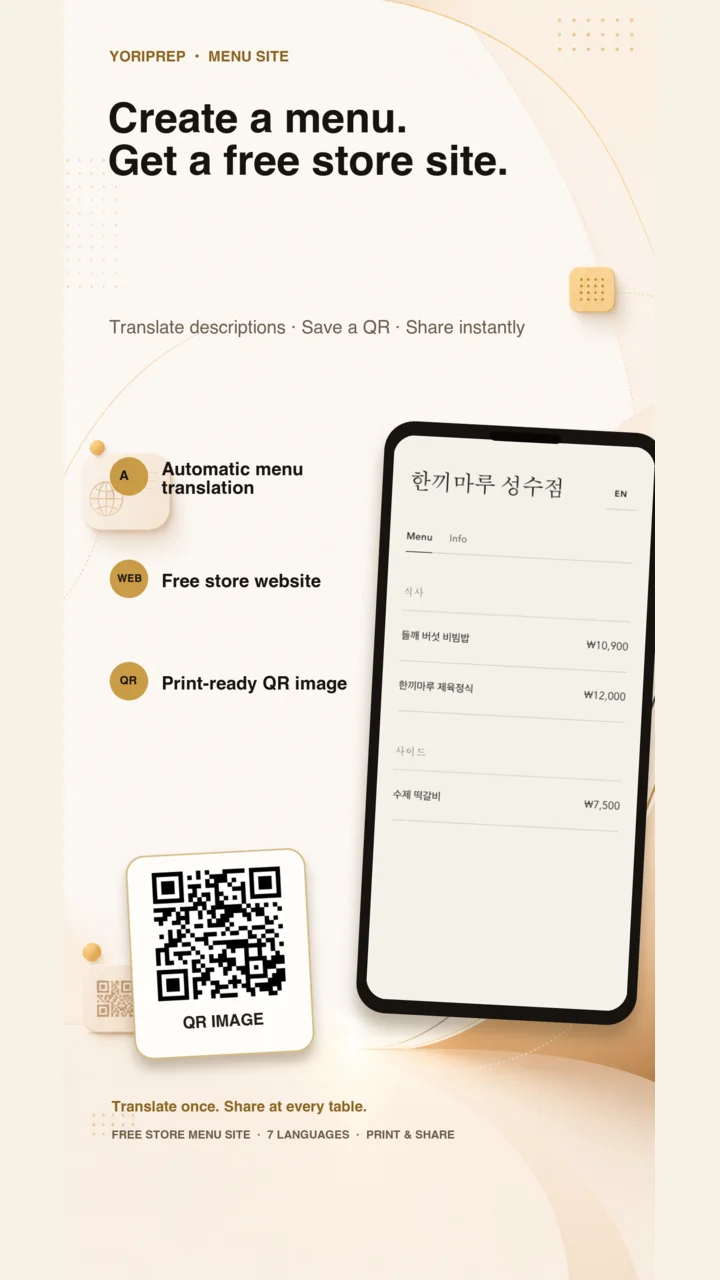
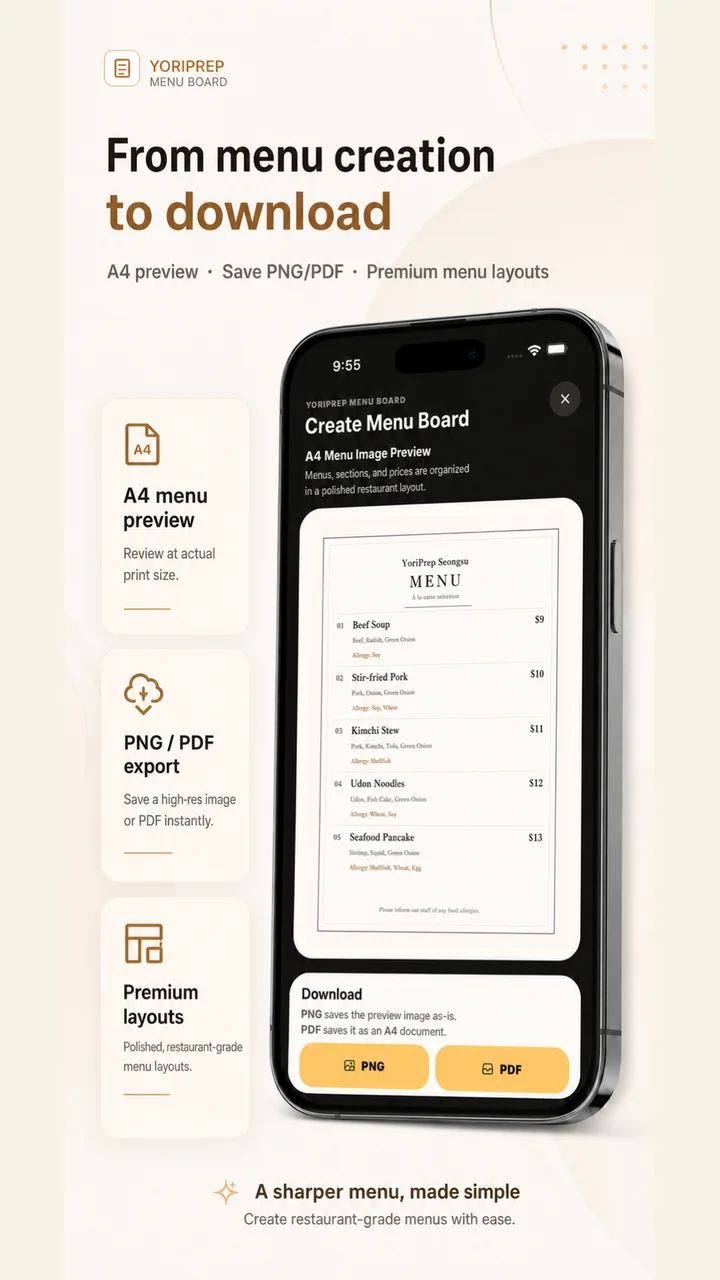
- Review menu and store details
Check price, public description, address, phone number, and business hours before publishing.
- Publish one store page
Offer Korean, English, Japanese, German, French, Italian, and Spanish routes.
- Save and share the print-ready QR
Use it on tables, packaging, and signs, then review visit activity.