Editorial method
Who makes this, how, and why
YoriPrep Editorial focuses each guide on one operating decision a food-service team can use on its next shift.
- Reference material only
- This article is general operating reference material.
- Case scope
- This reference scope is limited to the operating question and illustrative case described in “How much should a restaurant prep? A practical system for waste, stockouts, and handoffs”.
- Calculation limits
- The review formula is “Convert forecast sales, menu mix, recipe use, reservations, buffer, and usable inventory into the same unit before calculating.”; it does not determine a store-specific result without current inputs and context.
- Date markers from linked sources
- Years stated by the linked sources: 2026 · 2023 · 2022 · 2024. 2 linked sources state no date. Undated sources are not treated as current; check each link for its present status.
- Professional decisions
- Tax, employment, food-safety, accounting, and legal decisions need current official guidance or advice from an appropriate qualified professional. This article has not received that professional review.
- Publisher
- YoriPrep Editorial at Uberion selects the topic and is responsible for the scope of sources and examples in each article.
- Method
- Public sources are linked directly, and unsourced figures, percentages, and situations are labelled as illustrative. AI may assist drafting or translation, but advertising is limited to source-checked, curated articles.
- Purpose
- We publish to help readers solve one cost, stock, prep, or team-operations problem, not to mass-produce pages for search traffic.
Prep is not “make plenty.” It is a daily loop that connects a target, usable on-hand quantity, owner, due time, ending balance, and the reason for every exception in one unit.
A reconstructed operator case
We have waste and 86s. Should we simply prep more?
This fictional case combines public Naver and Google community questions with public guidance. It is not a measured result from a named venue or YoriPrep customer.- Venue
- 36-seat casual Korean restaurant
- Problem
- Lunch 86s, closing waste, missed handoffs
- Key prep
- Marinated chicken, stock, vegetables, sauces
“Yesterday we threw away chicken; today we ran out during lunch. Night shift says to make more, and morning shift says it cannot tell what is usable. What do we fix first?”
We did not change one number. We connected item name and unit, usable on hand, the reason for the target, owner, completion, and remainder on one line so waste and stockouts could be read on the same cause map.
1. Replace “plenty” with one unit
One team counted chicken by bag and another by kilogram. Sauce containers were not even the same size, so a number meant something different on each shift.
Each prep item received one count unit, standard container, recipe yield, and portion yield.
The first failure was not forecasting. It was counting the same item in different units.
2. Separate present from usable
The cooler held 18 portions, but six had no verifiable prep label and four were reserved for an event.
The operator separated usable, held, reserved, and in-production quantities. Only ten portions entered the service calculation.
Being in the cooler and being approved for this service are different states.
3. Record why the target exists
A seven-day average mixed weekdays, weekends, rain, and a group booking. It was easy to calculate but could not explain today’s target.
The target used comparable-day sales, confirmed reservations, menu mix, and holding time. Event adjustments were written separately and approved.
A traceable assumption mattered before a sophisticated forecast.
4. Give every line an owner and finish condition
The old board listed item and quantity, so long-lead stock remained until the end. A check mark did not reveal actual yield or location.
Each item gained an owner, priority, due time, actual yield, and storage location. Long-lead work was reviewed at shift start.
A checkbox is weaker than a defined owner, time, and observable finish state.
5. Use closing to tune the next par
A remainder alone did not distinguish weak sales, overproduction, poor portioning, or storage failure.
The venue attached remainder, waste reason, 86 time, and extra-batch quantity to the same item, then adjusted the next comparable day.
A useful prep list closes at the end of service and returns to tomorrow.
Prep calculation
Subtract usable on hand from the target
Convert forecast sales, menu mix, recipe use, reservations, buffer, and usable inventory into the same unit before calculating.Keep comparable sales and confirmed reservations visible.
Set the buffer by holding time and substitutability.
Count only what can be used for this service.
The operator then checks minimum batch and kitchen capacity.
Chicken prep for lunch
- Forecast lunch orders
- 80
- Comparable day plus reservations
- Chicken mix
- 40%
- 32 expected portions
- Approved buffer
- 4 portions
- Short recovery batch considered
- Usable on hand
- 10 portions
- Unverified and reserved stock excluded
(80 × 40%) + 4 - 10Prep 26 portionsWhether to make all 26 at once or split the batch depends on safe holding time and kitchen capacity.
This is an operating example. The operator must verify storage, labeling, cooling, holding time, and local requirements for each product and process.
Prep signals to fix first
An example ranking that combines frequency and service impact in a fictional kitchen.
Stocks, thawing, and marinades are difficult to recover when they start late.
Copying yesterday can create excess and an 86 on the same shift.
An item can be listed and still disappear between shifts.
Without the reason for waste or carryover, tomorrow returns to guessing.
These scores are an illustrative priority ranking for a fictional restaurant, not an industry benchmark or measured YoriPrep customer result.
Community questions and public standards
Evidence used for this guide
Community posts identify recurring operating questions; industry and government sources provide the cross-checks.Restaurant manager responsibilities
Naver Knowledge iN
A new manager asks where recipe setup, staffing, and inventory accountability begin and end. The community answer is not treated as legal or professional authority.
View sourceFrozen ingredient storage under food-safety rules
Naver Knowledge iN
A restaurant asks how to retain source and date information after dividing ingredients into containers. Official Food Safety Korea guidance should be checked separately from community answers.
View sourceBest way to calculate pars for main prep list?
Reddit r/KitchenConfidential
An operator links eyeballed prep with waste, missed long tasks, and slow list writing. Anonymous experience is useful for themes, not verified performance data.
View sourceWriting a prep list for a new restaurant
Reddit r/KitchenConfidential
A new manager asks how to start pars, waste logs, and 86 logs; replies connect sales mix with on-hand counts. Opening buffers still depend on holding time and production capacity.
View sourceKey results from the 2025 Restaurant Business Survey
Korean Ministry of Agriculture, Food and Rural Affairs
The share of preprocessed ingredient purchases rose from 23.0% in 2021 to 29.3% in 2025, showing prep labor is a live business decision. An industry trend does not prescribe the right prep model for one venue.
View sourceDoes Your Restaurant Need a Prep System Checkup?
RestaurantOwner.com
It connects standardized recipes, organized storage, daily counts, build-to pars, and station lists. Adapt the U.S. operating model to local labor and regulatory context.
View sourcePreventing foodborne illness in restaurants
Food Safety Korea
It covers receiving separation, storage, and retaining information for partially used packaged ingredients. Check current requirements for the exact product and business type.
View sourceFood Code 2022
U.S. Food and Drug Administration
It models operational controls for time, temperature, cooling, and date marking. It does not replace Korean or other local law and is used only as a structural reference.
View source
Turn today’s prep into tomorrow’s baseline
Read expected demand from sales, verify usable stock in ingredients, then connect the approved quantity to staff work and closing feedback.

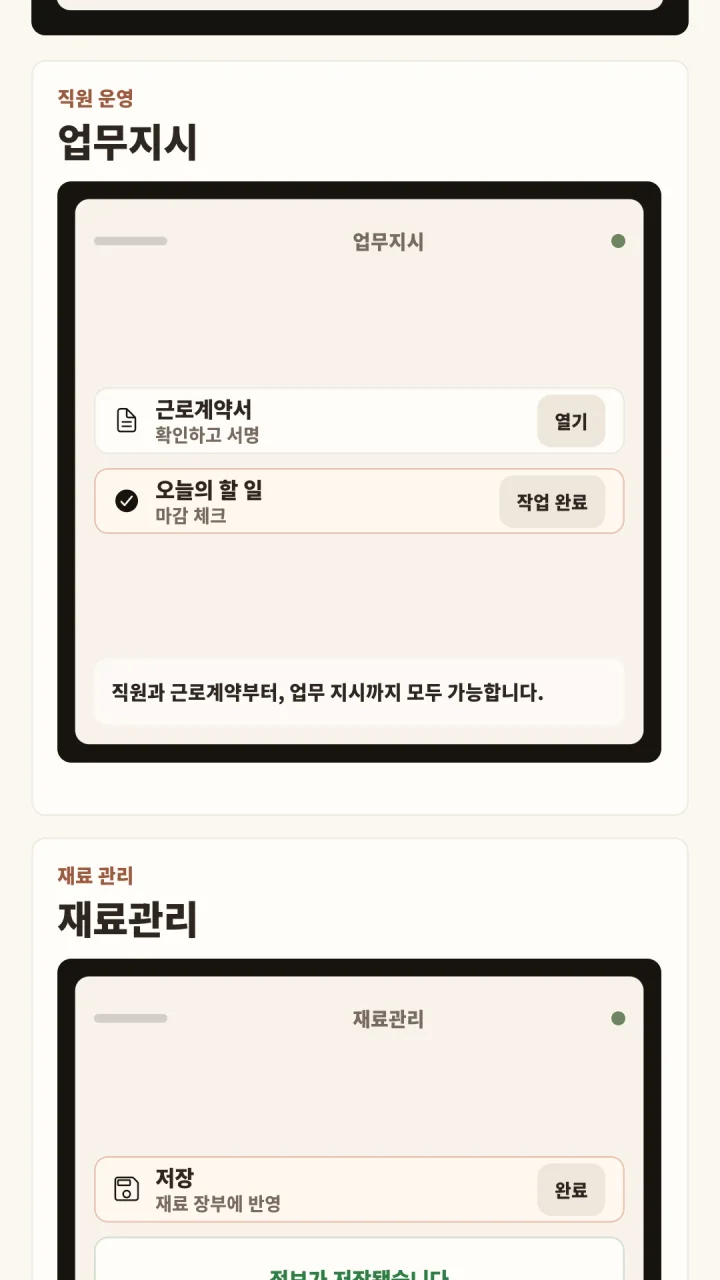
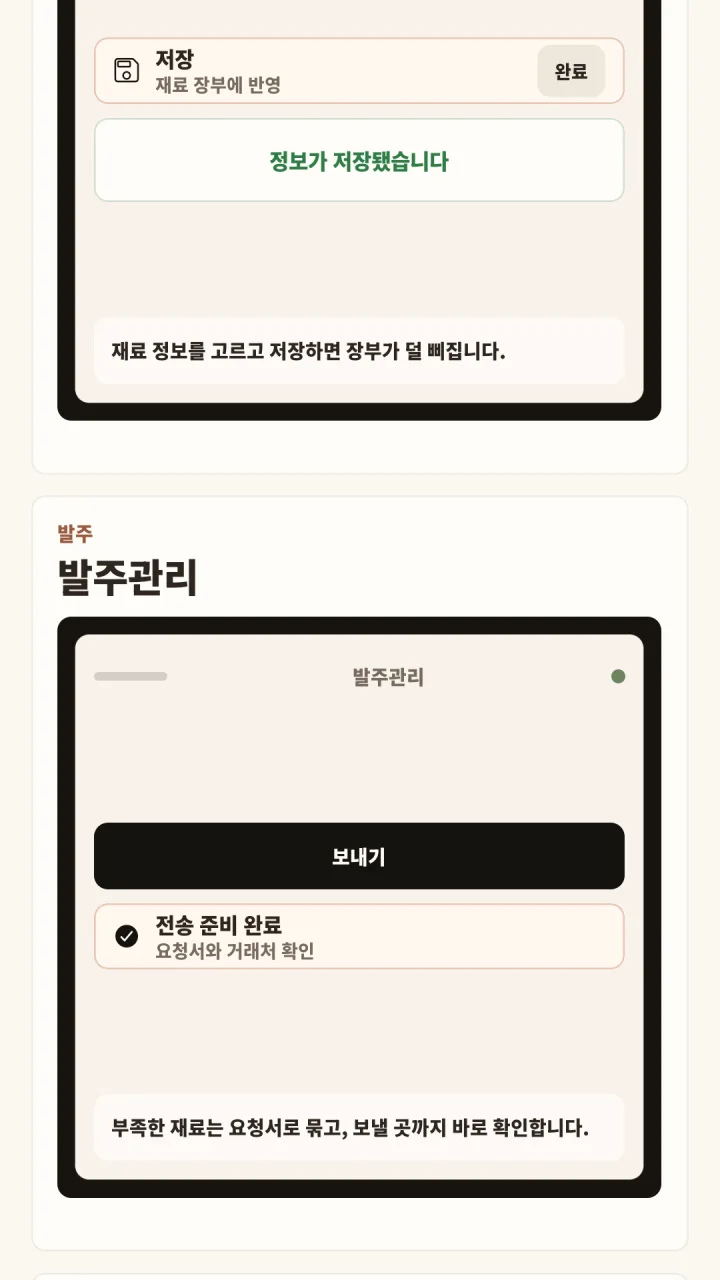
- Match sales, menu, and prep item
Use one name and portion usage to convert demand into a prep unit.
- Approve quantity from usable stock
Exclude held and reserved stock, then assign an owner and due time.
- Pass completion and exceptions forward
Record actual yield, waste, 86s, and extra-batch reasons on the same item.